Tuesday, January 24, 2012

About The Five Types of Prosumers

Euro RSCG has been conducting research about prosumers (professional consumers) for some time now. With the rise in social media use, the importance and impact of prosumers has been growing.

Prosumers differ from consumers. Prosumers have (relatively speaking) more influence, are more involved, and are more digital-savvy. compared to “regular” consumers. For brand owners, prosumers are important. Companies want to know what motivates them.

There are 5 prosumer archetypes based on social media use, the way content is shared, and reasons to be active on social networks

  1. Utilitarians are the natural allies of brands that make appealing offers

  2. Entertainers get excited by stimuli

  3. Advocates as a good citizen and to contribute to a better world

  4. Co-Creators support brands that approach them in a personal way and help them to come into contact with others

  5. Competitors assume that brands are in competition, as they themselves would.

To learn more about prosumers, check out the video below. It also includes world domination by Google in 2050 and Lawrence Lessig becoming US Secretary of Justice in 2020 and declaring copyright illegal!

Enjoy!

Thursday, January 12, 2012

A Steve Jobs action figure - just what Sheldon Cooper et al want….

It only took three months after the tragic passing away of Apple’s iconic founder Steve Jobs for a company to come up with merchandise. The company “In Icons” is going to launch Steve Jobs action figures.

The company’s website has pictures of the poseable Steve Jobs figure on its website. The figures are expected to be shipped in February and will cost $99.

The Chinese manufacturer believes that the 12-inch-high Jobs doll will become a collector’s item. They might be right; there is a lot of viral buzz and the item already appears on eBay for around $135.

If you take a close look at the doll, you will see that it is rather eerie. The level of detail is too much, including pores on Jobs' forehead, subtle wrinkles under his eyes, and veins on his hand. According to the company, the item will come with 2 pair of extra hands; 1 in case the original set goes AWOL and one set with pointing index fingers.

In case you wonder, the Steve Jobs action figure comes with a whole set of clothes and accessories that would make Barbie green with envy. Items include: 2 pairs of glasses, 1 black turtleneck, 1 pair of blue jeans, 1 pair of sneakers, 1 black leather belt, 2 apples (one with the iconic bite) and 1 bar stool.

Needless to say, Apple, Inc. is not amused. According to The Telegraph, the conglomerate is allegedly threatening to sue the toy maker unless they cease trading.

It would not be the first time; back in 2010, Apple blocked M.I.C. Gadget from selling a Steve Jobs action figure on Ebay, stating that the action figure was a violation of its copyrights and trademarks.

Saturday, January 07, 2012

FAQ that Companies Have for Their PR Agencies (Part II)

This post is the continuation from the previous one that you can find on my precious post.

7. Companies must have a dedicated (and charismatic) spokesperson

For startups, putting the CTO or VP R&D without any media experience in front of journalists and the media is disastrous. In many cases, the interview will result in a monologue about all the cool features of the amazing technology/product/service, peppered with tech lingo.

The journalist needs to write something cool that everybody can easily understand. Listen to the PR agency and your marcom; they will tell you who would be good for the interview and prep them accordingly. Technical information, including diagrams, should be sent upon request by email.

Please note that there is no such thing as “off the record”. Any information you share about upcoming investments, major deals or product developments will be covered by the journalist. Also make sure that all information submitted is accurate. A good journalist will do his or her homework and will know if you fibbed.

8. What you said is not always what you get

Journalists and the media can use received information as they see fit. A journalist might write about your technology under a funky heading that make you cringe. Journalists might even misquote or relate incorrect information. There is not much you can do about it, except asking your PR agency or professional to contact that journalist, thank him or her for the great article and gently correct the mistakes. Don’t expect a correction though.....The only way you can do damage control is on your own corporate blog, Facebook, or Twitter account.

9. Social media for PR entails more than harnessing the power of Facebook and Twitter.

Many countries outside of the US have there own social networks (and search engines). China uses Baidu, Russia Yandex, and the Germans prefer Xing over LinkedIn.

PR agency (or in-house professional) should also target the most influential bloggers in your industry, such as Technorati or the Huffington Post. Using op-eds is also useful, such as offered by the NYT are effective.

10. Professionals have been trying to come up with a “calculator” - without success
The best way for companies to get a grip on results is to ask for reports on progress and exposure. It is important to realize that exposure might take time. To give an example, the CEO of Curapipe was interviewed at WATEC on 19 November 2011. An excellent article appeared in the Mexican media on December 27; more than a month later. Due to the power of going viral, articles can be reposted and blogged about for a long time!

(Image courtesy of Jeff Bullas)

Saturday, December 31, 2011

FAQ that Companies Have for Their PR Agencies (Part I)

Companies and clients often ask a lot from their PR agencies or marcoms. Not without reason - since PR agencies work on a monthly retainer, the company wants to get maximum results.

As anyone in PR can tell you; it’s a tricky field. You have to put in a lot of effort and networking that is not visible to the company or client. In the end, it’s the results that count. Any company that hires a PR agency asks the same main questions.

In this post and the next one, I will address these FAQ.

1. No agency is in contact with all relevant journalists.

Yes, journalists of trade magazines and broadsheets relevant for you must be targeted - in the Americas, Europe, and the Far East depending on your business. But is it unrealistic to expect your PR agency to be on first name basis with all of them. They do have their own database and network though and will try to get you as much targeted exposure as possible. Please note that journalists don’t always bite. Yes, that is chutzpah considering how cool your company and product/service is, but that's life in the media lane.....

2. The location of a PR firm or professional is not that critical anymore.

However, if you are considering investor relations, it helps to be in or near the main financial centers, such as New York, Los Angeles, London, Paris or Tokyo. If you are targeting governmental agencies in the US, finding a PR agency near Washington DC helps, as does finding one in Brussels if you want to target EU-related governmental bodies and influencers.

3. Think local.

No PR agency is truly global. Many have partner agencies in other countries, which makes them highly effective. To reach journalists in Europe, you do need to communicate in the local language. No journalist of La Stampa, Le Monde, or Die Zeit will communicate with you in English.

4. You do need to send out press releases, but they must be newsworthy.

Publicly traded companies must put out a press release on any change that could influence investors’ decision to buy or sell stock (e.g., appointment of a new C-level manager or board member). Private companies can (and must) be far more selective. A new product release, major contracts, deals and partnerships, as well as received investments are all worthy of a press release.

To get the news out, I strongly recommend using one of the major paid distribution companies. My favorite is PR Newswire, which also takes care of translations and distributes to all media channels (including social media) in any region and industry you want.

5. A PR agency is only as good as the input they receive.

It is therefore crucial that you as a company or client share your goals, competitive information, and yes, all the relevant skeletons in you closet. Any publicity based on faulty or incorrect information, will backfire big time.

6. Some PR goals are unrealistic.

Get me on Oprah” is a mantra that companies have been singing for many years. Chances are very slim, to say the least. Sending out (by email) and uploading B-roll footage (e.g., to YouTube) to be freely used by the media is cheaper and far more effective. Cold calling the media is a waste of time (and money), trust me!

To be continued in Part II - keep posted!

(Image courtesy of Jeff Bullas)

Sunday, November 27, 2011

A Cute and Creative Application of QR Code

Quick Response (QR) is a good tool for creative marketing. A QR code is a 2D barcode. It is similar to the well-known 1D product barcode, but a QR code can contain far more (and different kinds of) information. Reading a QR code is different from reading a standard barcode. Apart from scanning the code with a barcode reader, the QR code can also be read by using a free application on a smartphone.

QR codes can be linked to a company’s website, a YouTube video, a photo or any other hyperlink.

Marketers quickly saw the possibilities of the QR code and started using them for all kinds of B2C campaigns. A QR code is easy to create as an image. It can be printed on business cards, folders, flyers, products, and yes, even cookies.

The German company Qkies offers its consumers the ability to bake cookies with edible QR-codes. The company allows its customers to put their own personalized code on top of the cookies. One package consists of dough and 10 edible QR codes. (Yes, the buyer must bake the cookies first). On the website of Qkies, the “baker” can choose to which website the QR code should point to.

Qkies is the brainchild of a German food company and DFKI, the German Research Center for Artificial Intelligence.

Thursday, November 24, 2011

Disney's Muppets Movie Edgy Marketing Campaign

Disney (NYSE: DIS) is releasing its latest Muppet movie, aimed at a wide audience. Apart from kids, Disney also wants to wow parents who grew up loving the Muppets the first time around.

The Muppets phenomenon has been around for 35 years. The latest movie has just been released in 3,440 theaters in the U.S. and Canada. For promotion, the services of controversial comedians such as Sarah Silverman, Ricky Gervais and Wanda Sykes were enlisted.

Similar to their hominoid counterparts, Miss Piggy, Kermit the Frog and Animal have hit the talk show circuit. They appeared on “Saturday Night Live" and “Chelsea Lately." When talking to E! talk show host Chelsea Handler, Miss Piggy was asked if there was any "penetration" involved with her relationship with Kermit. Miss Piggy’s love life was also discussed on "Jimmy Kimmel Live!", She responded that "there might be handcuffs involved, if you know what I mean." Move over Angelina Jolie! Miss Piggy’s love interest Kermit the Frog appeared on "The Tonight Show With Jay Leno."

The movie trailers are also catering to the mature audience. These trailers spoof "The Girl With the Dragon Tattoo" (with a trailer titled "The Pig With the Froggy Tattoo"), "Paranormal Activity" ("Abnormal Activity") and "The Hangover II" ("The Fuzzy Pack").

Disney marketing executives refrain from going on the record. But Disney executives obviously realize that going for a broader appeal of a youth-targeted movie is highly profitable, as Sony's "The Smurfs" showed. That movie grossed a neat $560 million at the global box office.

Interesting enough, the strongest demographic for "The Muppets" consists of women older than 25. (Source: research firm NRG). 95 % of women over 25 were aware of the movie and 37 % stated that they have "definite interest" in seeing it.

Saturday, November 19, 2011

The CardMunch Application Let You Scan Business Cards; Creating A Digital Rolodex At Your Fingertips

At WATEC 2011, a business contact showed me CardMunch, the latest cool application to capture business cards. LinkedIn just unveiled a completely revamped version of CardMunch, which it bought from Bowei Gai at the end of 2010. CardMunch is a free iPhone application that let you scrape business cards for vital information.

You snap a picture of the business card, and CardMunch 3.0 ties that business card with the person's LinkedIn profile. This gives you insight into mutual contacts, credentials, recommendations, etc.

What makes CardMunch powerful is its Cover Flow-like Rolodex feature. No more card scanners at exhibitions necessary; MunchCard lets you swipe through virtual business cards of all of your contacts. You can also add notes to contact cards while you wait for the cards to be processed.

You can also quickly add information from your contact’s CardMunch record to your iPhone address book. LinkedIn does not do this by default for all contacts, which shows you that LinkedIn truly cares about privacy. It is possible to send quick e-mails to contacts from within the application. It is also possible to initiate a LinkedIn connection request, but once "connect" is pressed, it cannot be undone.

It’s a great and free application to swipe business cards at exhibitions. Hopefully, LinkedIn will add some more features, such as: to "favorite" a contact, to sort contacts by company name/the date the picture of the card was taken, or to record the location where the card was scanned (e.g., Curapipe at WATEC 2011)

To grab the free CardMunch Application from the App Store, click here.

Sunday, October 30, 2011

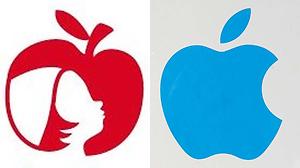
Apple Takes Action Against Cafe in Bonn for Infringing on Its Famous Logo

Apple (NASDAQ:AAPL) has sent a “cease-and-desist”letter to “Apfelkind“, a cafe in Bonn, Germany. Apfelkind („Apple child“) uses a logo consisting of a red apple with the silhouette of a child inside.

Owner Christin Römer submitted the design to the Trademark and Patent Bureau in Munich, Germany. She applied for 42 classes (categories), including fashion and service provider. She also stated that she would like to franchise her “Apfelkind” concept.

The legal eagles at Apple noticed that the two logos are very similar. Apple lawyers promptly objected to the submission and issued a “cease-and-desist” letter to Ms. Römer.

She immediately involved the German media, playing the David vs. Goliath card.

But things are not as clear cut as Ms. Römer might think.

The problem is not just having the logo on the building. She also sells merchandize with the logo (such as cups) online. She also writes on her website that she is planning to expand her webshop (there is already a picture of pillows featuring the logo).

Furthermore, her submitting the logo in the category “service provider” and announcing that she wants to build a franchise show that she is a savvy business woman.

Her claim that her logo was inspired “by the apple trees of my neighbors” is weak to say the least. She hired a graphic studio to do the design. Any reputable graphic designer will warn against piggyback-riding on famous logos.

How will it end? Ms. Römer has two choices: to spend a lot of money fighting for her patent, or changing the design and removing it from the “service provider” category.

In the mean time, she got lots of free publicity. She should realize that multinationals invested a fortune in their brand and are therefore highly protective of their logo.

The lesson to be learned here is to make sure that your logo, font type, slogan or color scheme do not even vaguely resemble those of other companies. Be original! It is not only better marketing, but also prevents legal problems.

Monday, October 24, 2011

Eight Simple Tps for Starting and Using Social Media

1) Establish a presence

This may sound redundant, but you need to be on the social media trinity: Facebook, Twitter, LinkedIn. LinkedIn is great for professional networking. Facebook is a more informal way to connect, although the business pages are very much B2B. People can “like” your business page, which is great for branding. Twitter is the cocktail party in social networking; just keep the tweets business-related!

2) Engage your peers

Your peers are your potential customers, business partners or employers, so you need to engage them with articles, blogs, comments and postings. It’d s great way to establish your brand and position yourself as a thought leader.

3) Make sure your target audience knows where to find you.

You need to promote the links to your Facebook, Twitter, LinkedIn and blog. An easy (and often overlooked way) is your AutoSignature. Make sure that you also link your website and blog to your Facebook, Twitter and LinkedIn.

4) Find your voice.

As the French say: “c’est le ton qui fait la musique”. Decide how you want to communicate with your target audience. Do you want to keep it formal (for B2B) or informal (for B2C)?

5) Pace yourself.

Avoid starting with many tweets and blog posts a week that are impossible to keep up. Too much activity can be overwhelming and lead to burnout. It’s better to set up a schedule for your social media and stick to it.

6) Keep it simple.

Tweets, postings and blogs should be fun and easy to understand. Try to avoid using complex language or concepts.

7) Visuals rule.

A picture can tell a thousand words. Use visuals in your blog and postings; people love it!

8) Engage.

You are using social media, so be social! React, like, and comment to other people’s posts. Be generous and informative. Again, it’s a great way to brand and position yourself as a thought leader.

Want to learn more? Contact me at www.tiptoppr.com

Saturday, October 22, 2011

Tattoo Barbie - Mattel's Clever Marketing Ploy

Mattel’s latest Barbie doll sports pink here, a trendy outfit and has tattoos across her left arm, neck and chest. This limited edition Barbie is the result of a cooperation between Mattel and Italy-based brand Tokidoki. The doll is marketed as a collector’s item for adults and sells for $50. This pink-haired, tattooed Barbie wears black T-shirt with heart and crossed bones, leopard print leggings and a dog called ‘Bastardino’. Supposedly, this has invited the wrath of parents across the U.S, and was debated on the O’Reilly Factor.

There is some understandable skepticism if the so-called outrage of concerned parent is real, or a clever marketing ploy by Mattel.

The Daily Mail did some digging and found a number of obscure websites for “tweenage” girls where people had a negative opinion of Barbie’s tattoos.

However, the majority of the experts that normally pipe up were silent. Quite likely, they just don’t see it as a big deal.

It’s not the first time that our Barbie got tattoos. In 1999, Butterfly Art Barbie was withdrawn from stores after parents complained. In 2009, the company released Totally Stylin’ Tattoos Barbie, a doll with removable sticker tattoos.

But it seems that in 2011, nobody seriously cares about a doll with tattoos. That leaves us with an interesting marketing question: did Mattel create artificial controversy to sell its latest Barbie? Knowing Mattel – quite likely! As usual, Mattel is laughing all the way to the bank. The doll is already sold out......

Wednesday, October 19, 2011

A painful lesson in copyright and graphic design – inspired by Steve Jobs

Social media has changed the game; in more ways than one. Let’s look at the case of Mr. Mak.

Mr. Mak, a university student in Hong Kong who is an aspiring graphic designer. Upon the passinga way of Steve Jobs, he designed a graphic of the Apple logo with a silhouetted profile of Mr. Jobs. It went viral and was even picked up by news media. Even actor Ashton Kutcher posted the design on his Twitter account. So far, so good...

But then, it was noticed that his design has an uncanny resemblance to the design of Chris Thornley, a British graphic artist.

Mak developed his design in late August using a white Apple logo on a black background. He used a black silhouette of Mr. Jobs indented in the apple as a tribute to Mr. Jobs after he stepped down as chief executive of Apple.

Although Mak said he had searched across the Internet both to ensure he was not infringing on another design, he did not come across Mr. Thornley’s design.

But his design turned out to be similar Mr. Thornley’s. Thornely designed a black Apple logo on a white background, with a white silhouette of Mr. Jobs. The angle is slightly different from Mak’s design.

A shocked Mak said he had received notification from Mr. Thornley’s wife, Julia, about the similarities of the two designs.

In the world of graphic design, similarities between images are quite common. This case illustrates once more how easy it has become to unearth similar images or outright copies. Mr. Thornley, a 40-year-old living in Darwen, England, acknowledges the dangers the digital age presented to creativity.

He is following the controversy while receiving treatment for a rare form of non-Hodgkin’s lymphoma. He stated that he first developed his design in May 2011. He wanted to celebrate the fact that someone who had cancer was still working, still driving forward and still thinking positively about the future.

The Internet can be a double-edged sword,” he said. “You need to use the Internet in order to promote yourself, but in order to do this you are making yourself vulnerable to these situations.”

Mr. Thornley went on to say that he hoped to speak with Mr. Mak soon about the two designs.

J. Mak has been as honest as he can about the situation, I think,” he said. “It is important to have the debate about this, and J. Mak has to be credited for opening up the debate and not hiding from it.”

Monday, October 10, 2011

Finding your target audience – the Jim Beam lesson

Jim Beam launched its Red Stag in 2009. This black-cherry infused bourbon was aimed at the male market. The company opted for a strong masculine product name and enlisted rapper Kid Rock to promote it.

Much to the company’s surprise, the drink was a hit with women. Female drinkers appreciated the sweeter taste compared to regular bourbon.

Jim Beam began to investigate. As its global chief marketing officer Kevin George stated: “We wanted to understand the emotional reasons why women drink wine or spirits. While women make up almost half of spirits drinkers, they consume just a quarter of the volume sold.”

As a result, after 216 years of marketing almost exclusively to the male drinks market, Jim Beam is embracing women. The company introduced three new products aimed at female drinkers: Courvoisier Cognac infused with red wine, Pucker vodka and low-calorie Skinnygirl cocktails. Skinnygirl Cocktails, created by American reality TV personality Bethenny Frankel, was purchased by Jim Beam. Since the drinks contain only 100 calories per serving, they are attractive to women wishing to avoid the calories of a typical 480-calorie restaurant margarita.

But also Jim Beam’s existing Sauza Tequila brand benefited from the switch to marketing towards women. As research shows, about 57% of all the Tequila sold in the US is mixed in margaritas. Two-thirds of those margaritas are consumed by women.

Sauza began a marketing campaign based on the idea of a “ladies night in”, hosting at-home margarita parties and advertising on the Food Network. Sauza teamed up with restaurants to create what they called “Sauzaritas”

Based on its success with the female market, Jim Beam is planning to introduce a new line of chocolate liqueurs called “Crave”. The drink will blend flavors such as mint, chili pepper and cherry.

Jim Beam’s marketing story proves that companies should never take their market audience for granted. They should be open to step out their comfort zone and check new opportunities.

Tuesday, October 04, 2011

Hoe Raines Rules opdrachtgevers kan helpen bij IT-investeringen

Raines Rules zijn een aantal simpele regels waaraan IT-investeringen moeten voldoen voor accordering door de President van de Verenigde Staten. Deze regels voor IT zijn in 1996 opgesteld door Franklin D. Raines, die toendertijd directeur was van het Office of Management and Budget, één van de executive offices van de President.

In ons land is Rijks-CIO Maarten Hillenaar een fan van de Raines Rules. Hij ziet bij IT-investeringen door de overheid zonder meer een rol weggelegd voor de Raines Rules. Hiermee kunnen zo in het voortraject van elk project vastgesteld worden wat een IT-investering financieel en beleidsinhoudelijk moet opleveren. Verder of de investering voldoet aan de referentie-architectuur en of alle beschikbare standaarden zijn gebruikt. Verder moet ook nagegaan worden of het al ergens is uitgevoerd.

"We willen als cio's binnen de rijksoverheid over dit instrumentarium kunnen beschikken om onze beleidsmakers te adviseren bij risicovolle ict-projecten," aldus Hillenaar.

Maar ook voor het bedrijfsleven kan het pakket Raines Rules een goed instrument zijn, vooral als het om grote IT-investeringen gaat.

Aandachtspunten voor een opdrachtgever zijn hierbij:

1. De ICT-oplossing moet de kernprocessen van de organisatie ondersteunen.

2. Zijn er alternatieven in de private sector? Zijn er andere (overheids)organisaties die het proces efficiënt kunnen ondersteunen?

3. Processen dienen zo simpel, goedkoop en effectief mogelijk gemaakt worden, met speciale aandacht voor gebruik van (commerciële) bestaande oplossingen.

4. ROI moet risk-adjusted zijn in samenhang met de complexiteit van het project, de managementcapaciteiten van de opdrachtgever, de kans op kosten- en tijdoverschrijding, en het risico van onder- of nonperformance.

5. De ICT-oplossing moet consistent zijn met al ontwikkelde informatiearchitecturen. Hierbij is de integratie van proces- en informatiestromen met de technologie die de kernprocessen moet realiseren van belang.

6. De opdrachtgever dient risico's te beperken, zoals alleen gebruik maken van volledig geteste pilots, simulaties, of prototypes. Hierbij is van belang doelstellingen te formuleren om vervolgen deze te testen en meten voor de uitrol.

7. Het ICT-project dient opgedeeld te worden in zo klein mogelijke deeloplossingen die elk aantoonbaar een eigen rendement hebben onafhankelijk van de nog te realiseren gedeeltes.


8. Risico's tussen opdrachtgever en opdrachtnemer dienen gebalanceerd te worden. Dit omvat optimaal gebruik maken van reeds bestaande commercieel beschikbare technologieën.

Voor zowel overheden als het bedrijfsleven is het zaak met een leverancier in zee te gaan die al jaren volgens deze Raines Rules werkt.

Wilt u meer weten? Neem dan contact met mij op. U kunt mij ook bereiken via Tip Top PR www.tiptoppr.com

Wednesday, September 28, 2011

Using animal symbols in marketing - not the cat's meow!

Using animals in marketing can be tricky. We all know strong brands that use animals: Puma, Jaguar and ING bank to name a few. But an animal may have different (and negative) connotations in export countries and other cultures.

In some countries, animals are considered to be a low life form. Using animals to promote eyeglasses is cute in the Western world, but a no-no in Thailand. (See also David A. Ricks "Blunders in International Business")

Based on Greek mythology, the owl in considered to be a symbol of wisdom (it was the favorite bird companion of Pallas Athena). Using an owl is quite common in Europe and the US (with the exception of hooters) for educational software and institutes. However, Asians consider the bird a symbol of stupidity. Not what you want in your marketing campaign!

Muslims consider dogs unclean animals. Any advertisement with cute dogs is therefore bound to fail. The same applies for showing women and men in one advertisement. Head and Shoulders adapted its advisement for the Arab-speaking market.

However, cats are extremely popular in Japan. Just think “Hello Kitty or google one of the many YouTube clips.

Kate Edwards in Multilingual magazine’s August 2011 article, “Animal Symbolism” points out that (animal) symbols need to be managed carefully. “In an increasingly interconnected world, we have to remain diligent in choosing our symbols wisely with the utmost care.”

Before using animals in marketing campaigns, check the local culture. See what kinds of ad campaigns are popular. If a pet is conspicuously missing, there is a sound reason for it. Checking local proverbs is also a good way of checking for cultural sensitivities.

As with all marketing material: think global, but act local!

Monday, September 12, 2011

Jonathan Stark’s Starbucks coffee card – a clever marketing trick from an app developer?


Mobile application developer Jonathan Stark (a mobile app consultant from Providence, Rhode Island) made his Starbucks card available for anyone by offering his Starbucks Mobile app on the Web for others to use.

His message read:

Need a caffeine boost? Use Jonathan's card. Want to buy a cup of joe for a pal? Or, more likely, someone you've never met? Use Jonathan's card.”

Stark posted an image of the electronic card, inviting anyone to copy it to their own phones.

"Jonathan's Card is an experiment in social sharing of physical goods using digital currency on mobile phones ...," he wrote on his site. "Based on the similarity to the 'take a penny, leave a penny' trays at convenience stores in the US, I've adopted a similar 'get a coffee, give a coffee' terminology for Jonathan's Card."

Needless to say, lots of people followed up on this call to action. After its launch in July 2011, the campaign went viral once it was covered by several tech blogs.

According to Stark, more than 177 people spent $3,651 on the card; not bad considering that the original balance was only $30 balance. A couple of times, some users transferred money to their own Starbucks accounts.

"It's been a bit emotional, actually," Stark stated. "People's reactions have ranged from accusing me of stealing to thanking me for renewing their faith in humanity. It's been very uplifting overall, but it does hurt when the occasional pessimists send negativity my way."

How did Starbucks react? “We think Jonathan's project is really interesting and are flattered he chose Starbucks for his social experiment. We're curious to see how his project continues to evolve."

In the end, it all came to an end due to Sam Odio, who wrote a script that let him transfer large amounts of money from Jonathan’s Card to his own personal card. Once Starbucks became aware of Odio's efforts, the company shut down Stark's card. "We were concerned with fraudulent activity," a Starbucks’ spokesperson said. "Starbucks was supporting the program from the sidelines, because it was an interesting thing, and in line with the pay it forward mentality. But the very concept of sharing a card violates our company's terms of service. "

One thing is certain: Jonathan’s card was an interesting marketing experiment in collective consumption and mobile currency – and excellent branding for Jonathan Stark himself!

Saturday, August 27, 2011

Abercrombie and Fitch’s Reverse Endorsement Deal – What a Situation!


Mike “The Situation” Sorrentino of “Jersey Shore” fame, has been asked by Abercrombie & Fitch (ANF) to stop wearing their clothes. The company is willing to pay him for this, which makes it a reverse endorsement deal.

On August 16, Abercrombie announced their decision to disassociate from The Situation, stating: "We are deeply concerned that Mr. Sorrentino's association with our brand could cause significant damage to our image. We understand that the show is for entertainment purposes but believe this association is contrary to the aspiration nature of our brand and may be distressing to many of our fans." Funny enough, Abercrombie & Fitch itself has courted controversy with racy catalogs and questionable products.

From a marketing standpoint, it is quite likely that A&F will be laughing all the way to the bank. "It gets their name further out into the marketplace with one of the hottest brands on TV right now at the peak of the back-to-school season," said Wall Street Strategies analyst Brian Sozzi. "It's free marketing. Because the approach is so ridiculous, everybody's talking about it."

MTV, who hosts Situation's "Jersey Shore", responded to Abercrombie's money offer with a statement: "It's a clever PR stunt, and we'd love to work with them on other ways they can leverage Jersey Shore to reach the largest youth audience on television."

Abercrombie and Fitch may not want Jersey Shore’s Situation wearing their clothes but Larry Flint wants Mike Sorrentino for his Hustler brand. Larry Flynt told TMZ: “The Sitch may not be good enough for Abercrombie & Fitch, but he’s good enough for us.”

Is this move by A&F a clever PR stunt? Will reverse endorsement deals become popular? Time will tell.....

How Net Promoter Score (NPS) Measures Customer Happiness

Companies want to know if their customers like their products and services. Net Promoter Score (NPS) tracks how likely is it that they will recommend the company’s product/service to a friend or colleague, using a 0-10 point scale, and tracking the ratio of “promoters”, “passives” and “detractors”.
  • Promoters are loyal enthusiasts who will keep buying and refer others, fueling growth. They score 9-10.
  • Passives are satisfied but unenthusiastic customers who are vulnerable to competitive offerings. They score 7-8.
  • Detractors are unhappy customers who can damage your brand and impede growth through negative word-of-mouth (WOM). They score 1-6.
Apple (AAPL) has some of the highest NPS scores of any sector by careful listening to what customers have to say and responding to it.

Apple made its retail stores to places where people can gather and learn, not just buy. Apple learned that customers want an ongoing relationship with Apple and not a one-off purchase transaction. Apple opens on average between three to five stores a month worldwide, using the NPS to check how effectively each store is meeting expectations.

Apple uses the NPS in its daily management of its more than 300 stores. Apple’s central NPS team analyzes customer feedback from all the stores to understand the systemic reasons for promoter’s enthusiasm or lack thereof.

Apple store employees who create promoters are recognized by store management. Each day, the “daily download” takes place, when employees review the NPS feedback and discuss how to adjust their work accordingly. Detractors are phoned by Apple store managers within 24 hours resulting in additional sales of $25m yearly.

Other companies that use the NPS are: Intuit (INTU), Philips (PHG), Southwest Airlines (LUV) and Allianz, They all use NPS to monitor customer satisfaction.